
Ask Alicia Anything.
A collection of questions I've been asked over the years 🙂 Most of the answers were originally written for my old blog and have found a new home here, so feel free to ignore the dates. Thank youuu! 🤓
Also, there’s a bunch of FAQs, if you so please.
Unpacking worth.
I had the pleasure of hanging out with and being interviewed by Shreyans Jain a few months ago, and it was all kinds of lovely (obviously!) — not just because he’s great to chat with, but also because I absolutely LOVE talking about what I do. I mean, what a privilege — and a bit of winning the cosmic lottery — to adore what I get to do for a living and still enjoy it as a hobby in different ways!
Anyway, chatting with him made me want to write and talk so much more about the nuances of this field, working as a freelancer, and the big ol’ juggle that comes with it. But for now, just a few thoughts — because I did the very difficult thing of listening to myself (on 2x speed, no less — which, if you know how fast I talk already, was... intense) to see if there were things I wish I’d phrased differently.
Turns out — yes. A few small things I’d elaborate on. But one thing in particular got the most messages after the interview:
Salaries and illustration costs in India.
In the interview, I mentioned that ₹5K per illustration isn’t a lot. And when I started out, I worked on a project that paid around that (actually ₹6K) — but it was for an entire book. Which, yes, is a whole lot of work for very little money. But weirdly, it was also one of the best things I did.
It helped me get on my feet. The client truly couldn’t afford more (but they were lovely, and wonderful to work with), and it gave me something solid to add to my portfolio. It made sense at the time.
So, it depends. That said — if you’re looking to make illustration your career, you have to charge realistically as you go on. Ie, increase as you grow. Otherwise, it just won’t be sustainable. Take that ₹5K project if you need to. Take many of them if that’s where you’re at. Just keep an eye on the fact that, eventually, you need to move forward. (Also, a little note- it’s A-ok to take if it’s fitting to how quickly you finish a drawing, who it’s for, size, usage etc.)
What I didn’t stress enough: There’s no one right answer.
(Okay, there are some wrong ones — like working for free. Except maybe in a few very specific, personally meaningful scenarios — like a cause you care about deeply.)
Ultimately, you’ve got to do what works for you, at your stage. Most freelancers go through that muddy patch of figuring out pricing, fees, and boundaries. It’s confusing. It’s awkward. It’s normal.
That’s all for now. Thanks for listening (and for putting up with 2x-speed me)!
Styling Stuff.
…Lastly, as an illustrator you stuck to a distinct style and created a product line with that style. While doing so did you ever face the dilemma that it would feel restrictive in terms of exploring different mediums and styles. I being a less experienced artist too aspire to have a product line based on my artwork and I do understand how it requires to be cohesive, having said that I am often conflicted with thoughts of wanting to explore more mediums and styles as I haven't fully extracted my potential. So, to sum it up if I were to develop a product around a particular style can I variate within that exploring more mediums, adding newer textures, brush effects etc. and mature the style as I grow? as I still don't work with a distinct style.
-S.S.
Dear S,
When I was in uni, I had a very different illustration style. In fact, I really didn’t have a style as how I drew changed every few months, depending on the new medium I found fun or discovered at the time. It was not until I started working on Chumbak, and I had more things to draw than time to experiment, that my style stayed put. Having said that, since then (i.e., way over a decade ago) to now, my style has changed or rather evolved tremendously.
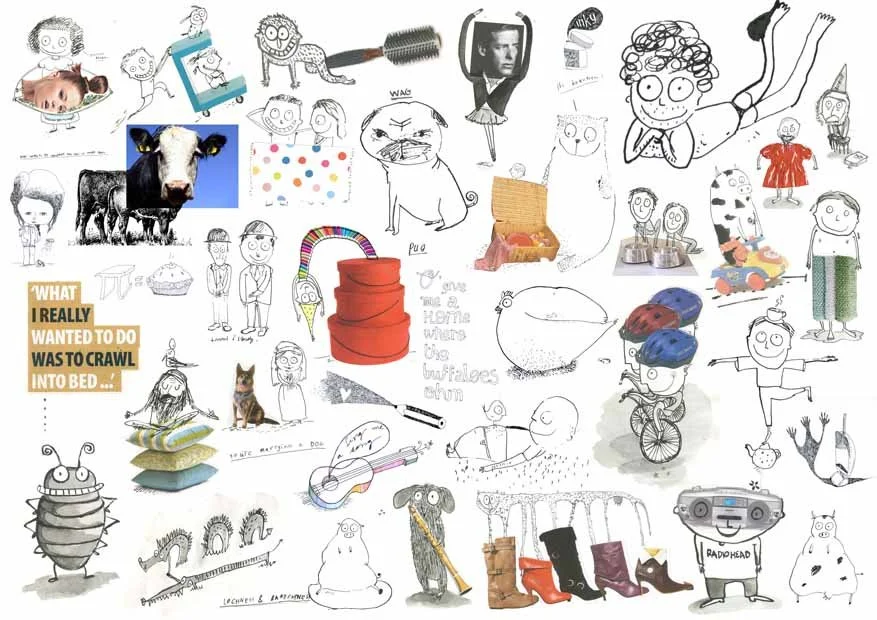
A style I absolutely loved drawing in was with cut-out magazine pictures. Very collage-y. This was when I was in university!
One of my mentors when starting out, Bill Wood, could draw in a variety of styles. I realized this worked to his benefit because clients came to him for multiple types of projects, from kids' books to instructional booklets. So from then on, I realized style may not be the only reason why one gets clients. I ultimately got stuck on a style because I drew in a way I was most comfortable and also the one that was quickest for me to churn out drawings.
Because I’ve been in the field for many years, my style is an expectation from my work when a client approaches me. But this also means that potential clients may not approach me because of it (for example, a serious topic might not seem like something I would be able to render in my illustrations even if I actually can). So, if you feel like you’re not comfortable with a style, you need not have one. Experiment! You may stick to one ultimately, or you may not- both can work!
When it comes to products too, it’s kind of like going to a shop. Sometimes you go to a shop where you like the ‘style’ of products that are sold, but sometimes there is a shop that has cool things and not a particular ‘look’ running through all the merchandise. Again, both work, both are fun!
Hope this helps! And all the best on your drawing journey :)
Love, Alicia
Digitisations and drawings.
There are few things I consider an extension of me, and if you asked me when I was a student, I would have said a pencil- now it’s Photoshop. I adore Photoshop and use it on a daily basis. A few over-users will understand me when I say that I sometimes think in Photoshop 🤓. Anyway, starting out on software was harder back then than it is now. I started transitioning because I needed to get my illustrations digital, be it for a college project or just to put on my blog I had then. So that’s where my first, and only, scanner came in. From there it just graduated to using Photoshop to make scans look better, then to colour, then to use in illustrations and print, then for work and now for everything.
I truly think the amount of digitization one wants for their drawings is purely personal but ultimately, it almost always HAS to end up as a soft copy if a drawing needs to be utilised commercially. If not, then it’s your call! That’s the beauty. I never completely transitioned to digital because I adore hearing the sound a pencil makes on paper. That scratching sound is one of my living pleasures.
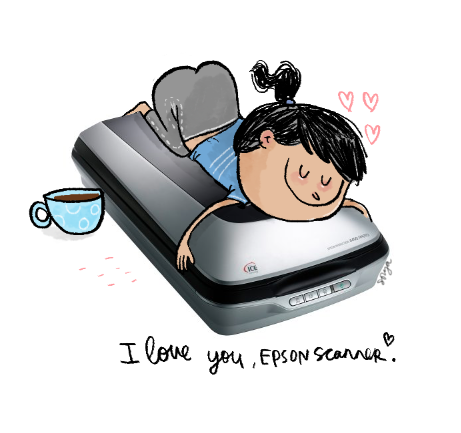
I used this specific scanner to do easily over 10,000 scans. I’ve not had that great a scanner since. I just have a relatively inexpensive Epson one now.
It’s only till the Apple Pencil came out that I started even drawing digitally. Till then it was a mix. Now I get through many projects entirely digitally but mostly because it’s a very big time saver, than my usual little tedious process.
Hope that helps! More pencil power to you, digital pencil or lead :)
Alicia
3 way street.
Email from A:
…So basically I was working at a company which I recently quit and now sitting at home doing freelance isnt as great as it was to do it on the side along with my steady job.
And I realised i like being around people while working...need activity and some noise around me.
But right now I am in a confused state of mind whether to start something of my own or still apply and look for jobs because I want more exposure( i have worked only for a year after graduating).
Because starting up requires a plan and money to run it which I thought i would do along side a steady job where I can save a little every month to put into my business.
Another thought from parents is that I do post graduation and then get a good job outside.I am basically now stuck in a situation where i have 3 doors to open and I don't know which one to choose.
Cheers
A
Dear A,
So, there are many, many routes to reach one destination, and that’s what's so great about, I guess, life! It’s great that you realised what works for you and what doesn’t, as that’s really important. There are ways to be a freelancer and have the niceness of white noise with co-working spaces. Many have popped up around the city and have great reviews. Though I personally love the ultra-quietness or loud country music (that is pretty much unacceptable in any workspace haha), a co-working space could be a solution if you love every other aspect of freelancing.
Starting something of your own does need a bit of an investment and a plan. Initially, unless you have a partner, you’ll still be working alone. I’m a little unsure when you say start something of your own; do you mean a service-based company or product? Because for service-based, time will pretty much be your biggest investment.
A steady job would help if you want to start a company that requires an investment, but making time to work on the side of the ‘bigger picture’ is hard when one has a full-time job. It can work, but this is a matter of what kind of job and where. If you can make it happen, then this is your best bet! It’s less risky because you get to meet more people (given that your job allows that), earn an investment, and build up what you want slowly and steadily until it takes over completely, and you can seamlessly shift into your own space.
I’m always wary of suggesting post-graduation as unless it’s something you really ‘need’ to study, it’s just a framed print and time away from getting real experience in the workspace that is worth, usually, a lot more. Having said that, it’s a personal call because sometimes that break is something you need for yourself, and that community of students is what you crave.
Anyway, I hope this helps. I know I didn’t give you one solid answer because I think only you can pick the path that calls you the strongest. But, pick one not based on what’s the least scary but the one that could bring about the best outcome and happiness. :)
All the best!
Love, Alicia
Blocks and all.
Email from 'Said':
:-)
Hi Alicia,
Thanks for the mail. I would like to know your opinion/suggestion on two more things (Won't take more time of yours .. promise)
1) Do you get something like a writer's block? How do you overcome?2) As a kid, I had a huge desire to 'live' out of drawing. Now when I see, I feel maybe that was the reason why I stopped .. as I found it difficult to monetise on the skill. Did you have a similar phase/doubts? Or the 'living' part 'just' happened? How do you keep the 'need for money' separate from your art?
Thanks
Hellooo,
So let me get straight to it!
1) I used to before I drew for a living. I remember when I was at university, there were sometimes 4-5 weeks that would pass by where I just didn’t feel like picking up a pencil and then suddenly I couldn’t stop drawing the week after. But I think now I can’t even imagine not drawing daily. I believe it comes from making it habitual. Habit to draw but also sometimes practical when it comes to what to draw. There are days when I can sit in front of a blank paper and stare without a thought, and that’s when I refer to notes I make about ‘what I need to draw’. I make these notes at random times when I am in the middle of other activities and don't have access to a pencil. I feel like it’s almost like cooking sometimes. You can sometimes whip up something just by looking at the ingredients but sometimes you need to flip through your recipe book. My notes is sort of like a recipe book, noted when something crossed my mind. This is also because I have an awful memory and need to write everything down or I’d never remember!
2) That’s a great question! That’s one of the reasons I said I WOULDN'T be an artist as a kid too! And well, life has a funny way of making your ‘wouldn’ts’ come true :) I kind of fell into freelancing and that meant I had to come out of my comfort zone and talk about money to clients and put a figure to my work. When it comes to client work, it’s a job and not a piece of art because art is about feelings and messages whereas client work is about fulfilling a brief, even though you have to/want to put in feelings and a message. That’s something I make clear to anyone starting off as well. Realize that when you illustrate commercially, you’re never given a blank canvas. Having said that, it’s sooo much more fun than it sounds. It’s challenging in a nice way where you work within the constraints but in the most creative way. It's also personally challenging because you have to do things that you don't always prefer, like talking about money (which is a big worry when starting out) but you get used to it over time. Be open in thought and accept challenges.
But at the end of the day, you should also always draw for you! And that's when you can have a blank canvas and the separation that one may desire.
Hope this helps!
Love, Alicia
Making stuff.
Email from Jaai V:
Good morning Alicia
Thank you so much for the reply. I went through your blog and all the questions. Yet I have a few more questions and I think only you can answer them.
1. How did you get your first order for designer merchandise? I am very much interested in starting my own online store business and selling designer merchandise and accessories but I don't know how to start and whom to approach. I make Illustrations but I don't know how to earn a living out of it.
2. How do you collaborate with big brands like Lenovo, Tinder, etc. I have no idea about how to approach well known companies. Do they get in touch with you or you contact them?
3. Do you manufacture the cute illustrated products or do you get them printed? Whom to contact and how to collaborate with manufacturers of products?
4. Where do you store all your products before shipping? What is the process when you get an order? For example, you get an order for a designer bag then is it ready to be shipped before hand or you get your artwork printed on the bag later? Can you please guide on how to approach manufacturers and collaborate with them?
Your inputs will be of great help as I am very much interested in designer merchandise.
Thank you so much for your guidance and help. You are an inspiration.
Regards,
Jaai Vernekar.
Hello Jaai,
Thank you soooo much for your mail! So let me reply in order to your questions, so I don't miss anything out:)
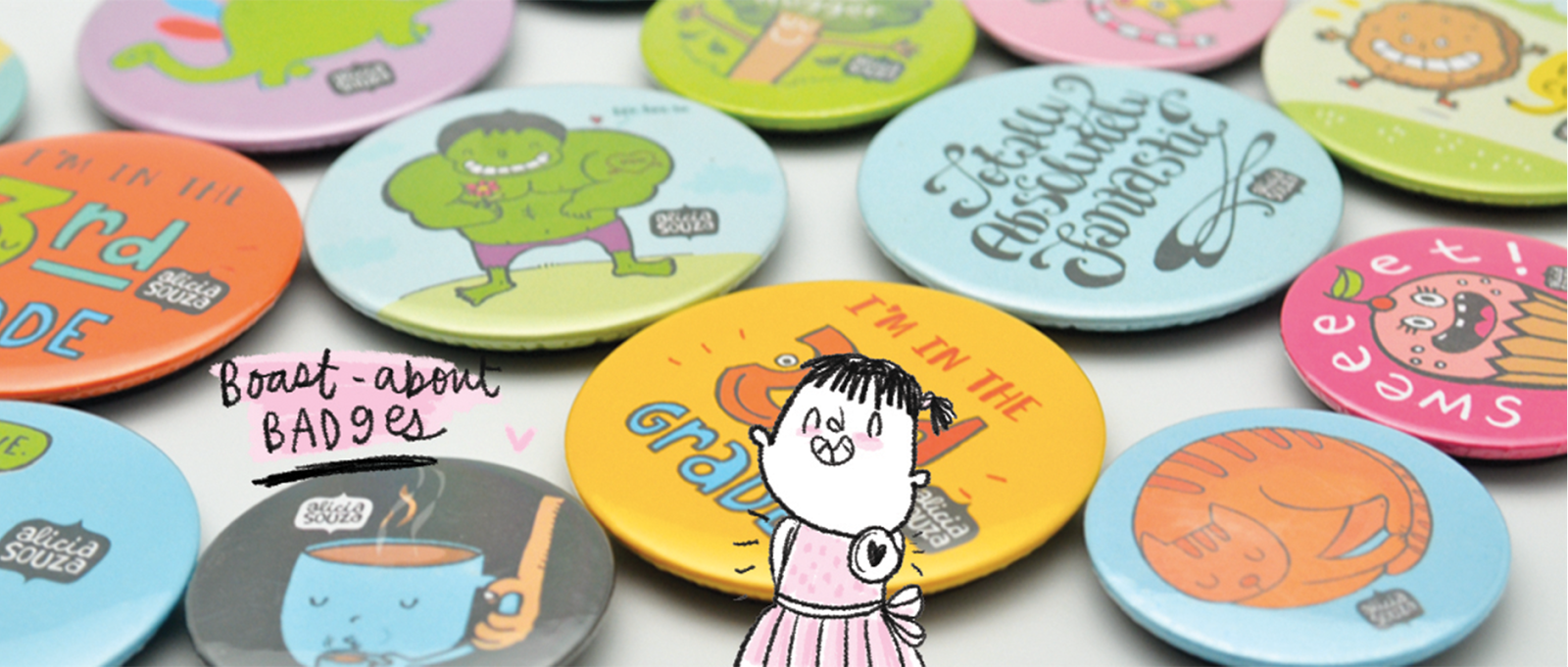
1) I think I was a bit lucky on that front. I had a few people ask for merchandise before I even considered it. But I took a risk, thanks to the help of a friend, of making a few products for a flea market event (the Sunday Soul Sante), and we ended up selling out and having people mail with queries for months after. That was when I realized there was a need; though it was a long time later that I started the online store, stopped, and started again! When it comes to merchandise, I think the thing to realize is that it’s an entire different ballgame. Handling the manufacturing, stocking, logistics, and then sales is a full-time job (depending on how viable/profitable you want it to be). But getting your products manufactured is as simple as going to the nearest/biggest print shop around and getting your work printed on the merchandise that’s easily available to be customized. This could include t-shirts, mugs, badges, prints, etc. Basically things you can make small quantities without worrying that you’ll be stuck with a whole lot of stock. I would say look at it as a testing project first and then go guns banging after doing the math of the business. It’s a little less risky and gray-hair-starting.
2) I think I’ve been lucky enough to be contacted by every client who I’ve ever worked with. It’s also because I’m rather public with my work (though I only sometimes showcase client work). I would recommend getting a portfolio of your work online first because when you approach a potential client, you want to show them your capabilities. Then, go ahead and approach them! We live in such a beautiful age wherein most people are just an email away! And that too, an email address that can be scouted with just a bit of research! Mail and mail some more. Showcase your work. Also pitch some ideas! The sky is the limit!

3) Yes, we manufacture each product. We work with manufacturers (sometimes two and even three on a single product). I started off, as I mentioned, at the local print shop. That worked for a while, and then I took a break because running a product business meant that I had to be doing it full time. Which also meant that if I was single-handedly doing the packaging and shipping, I had to be in town almost all the time, which is not possible with my schedule. It wasn’t until I met Saurabh, my current partner, that we started the online store on full swing. Finding manufacturers is a task in itself, and to be honest, I don’t have an interest or capabilities (language!) for it, nor do I enjoy it. Figuring out cost prices along with follow ups for timelines and MOQs (minimum order quantities) is something that can take more time than I have to offer. So my partner handles that side of the business while I do what I love, i.e., the drawing bit! Back to my beginnings, I think the local print shop should do just fine initially and if it’s something you want to pursue after the first few lots, then I would suggest getting someone to help with the business side of things, including finding manufacturers (this is sometimes asking current manufacturers and just plain ol’ Google searches!).
4) When I started, I only stocked smaller products under my bed in boxes. Also under my housemate's bed. It was a mess. Every time there was an order, I’d had to pull them out, pack them, and call the courier guy who would send it across. It took a LOT of time in my day even if the number of orders weren’t too many. At this point, we have a little office with a storeroom for all our products. I still recommend going through the hassle of the home storage before investing in a storage room because the number of orders will dictate if the business is worth growing and investing your time and money. Almost every order is pre-manufactured, which means we have stock of products. But we do have a few products (like our custom stamps) that we manufacture on demand. That’s only something we’ve been able to do with a team and process in place because it takes longer and also involves working with a manufacturer every time an order comes in. Custom orders tend to be a lot more expensive (depending on the product) because you manufacture single units, which means it’s a lot more effort from the manufacturer's side and a lot of time from yours too! So unless it’s a high-value product, like say a bag as opposed to a badge, I wouldn’t think it would be worth getting into.
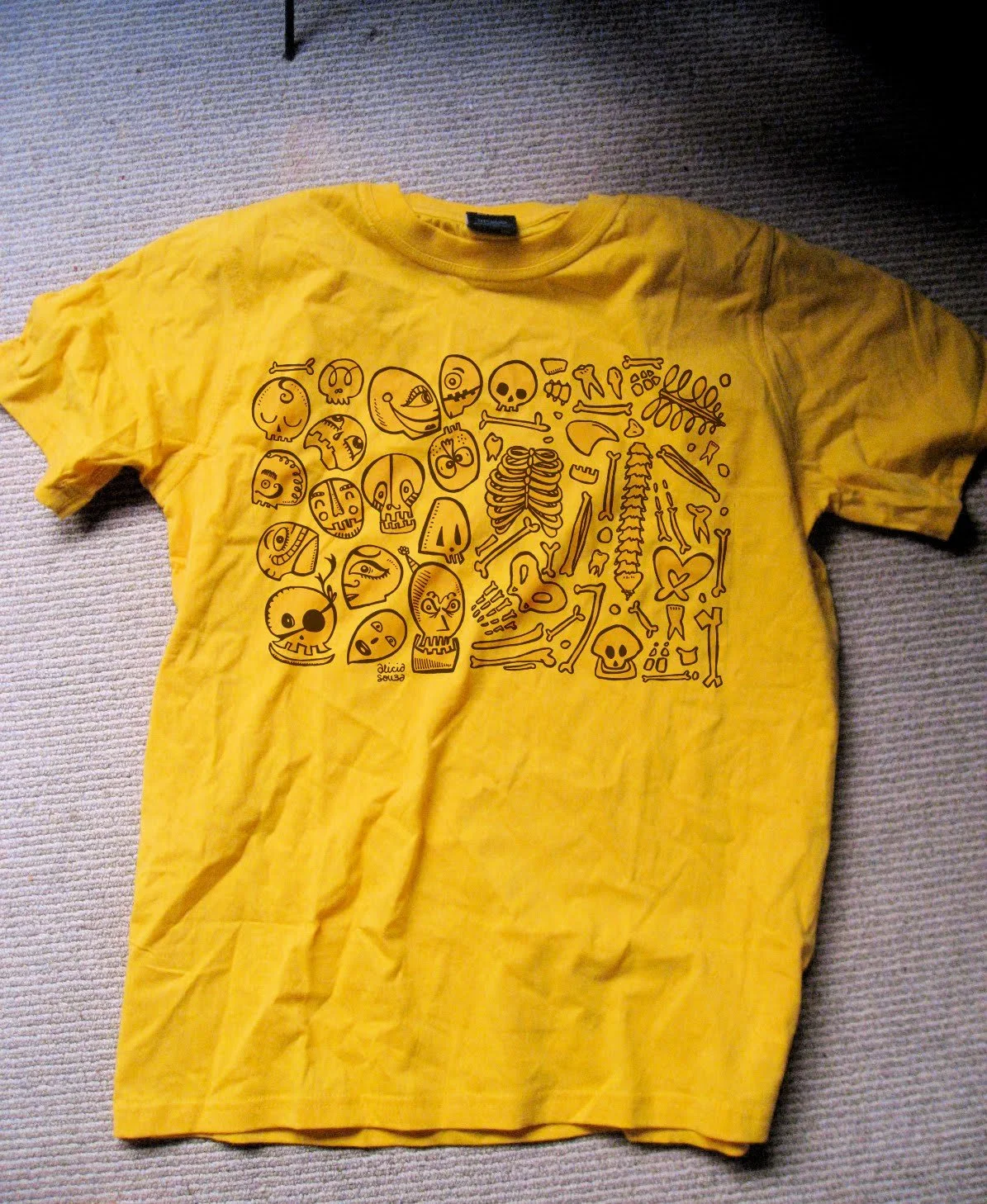
A shirt I mocked when I was in university. I used to draw more skulls back then haha!
Lastly, you should also start mocking your illustrations onto products. I did this from my university days, which was when I knew I would love to see my work on merchandise. Mocking is still something we do because I cannot get everything I envision manufactured, so I mock it instead! Hope this helps! All the best and don’t be afraid to take a risk!
Love, Alicia
PS: Take everything I say with a pinch of salt! I took one direction and got to where I was, but walking in a completely different path may get you ahead of me! So don’t be afraid to do what you think works. I don’t take the most riskiest paths but maybe you would like to! Go ahead! Your life, your path :)
A happy state of affairs.
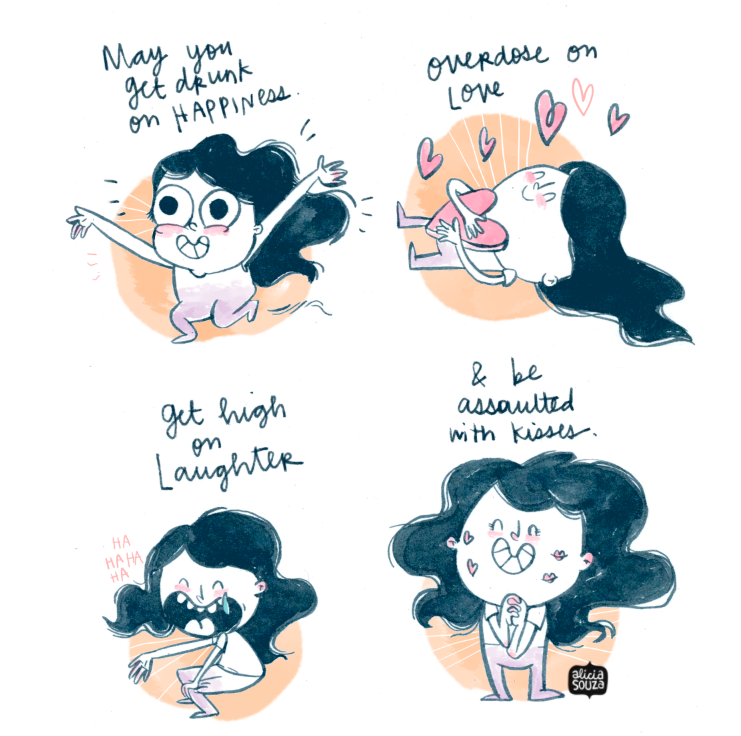
Email from ‘Awedowl’
‘warning : The following content is not from a cheese factory, so if you feel inclined to dismiss it as unreal, you can not. because you have to believe every word that I say :p
I have ordered from a lot of places, and always I have purchased objects. But from your beautiful store I ordered smiles and happiness, and Whoa! I got so much more than I ever wanted. You are an inspiration Alicia, and I admire you so much.
Can I ask you something? I am stretching my limits as you have been so gregarious and warm. How do you deal with sadness? I really want to know. I am sure that there must have been moments when you just want to shut the World out and scream maybe. How do you come out of that zone?
If I could I would've borrowed all the blessings the Planet has to offer and showered them on you :D'
Your email is the cutest ever!
I loved your question because it’s so real. Like any human, I have a wealth of emotions. I don’t feel sadness as much as I get internally peeved. I sometimes think my brain wires are a bit mixed up. Something bad happens in the world, someone passes away, horror-stricken event, whatever the calamity, I tend to feel irritated rather than melancholy.
Having said that, I do have sad streaks. And unlike some artists and writers who can create beautiful works from those emotions, I don’t even remotely feel like drawing then.
There are a few things I do when I get in this state:
1) Do whatever I feel like doing - I would rarely feel like drawing, but I truly enjoy just inking pencil sketches and would scout out drawings that are yet to be inked. This is my sort of ‘peace’ and ‘meditation’ that gets my brain almost still without thought.
2) Play my favorite music - I ADORE country music, and I sometimes listen to (wait for it…) old sappy country music when I feel crappy. I do admit that I also listen to country music when I’m happy, but I think I don’t listen to upbeat ones when I’m sad because I just get annoyed. (I heard, or hope, this is normal. Almost like misery loves company… of sad songs)
3) Confront the sadness - I don’t like leaving things in the air. If I had a tiff with the man, I would go back in there (in about five minutes) and clear it up. I also force-hug and force-kiss because that just makes things awkward and better. With people, it’s easy to just take a deep breath and confront the source of the sadness.
4) Time - And then there are things you don’t have control over that just need time to get better. Understand that things DO get better with time. (I have to throw in here that one of the most devastating moments in my life was when Cookie-brown, my dog, passed away suddenly. I thought I would never be able to get over her heart-wrenching loss, but time really did help. Nothing else, besides her being back here, would. Not even Richard Gere, and I like to think he would make everything better.)
5) A box of you - Another thing is knowing what you like and makes you happy. One of my dear friends watches horrid reality TV shows to make herself feel better. I sometimes like cleaning or baking. Maybe a box of fun photographs or mailing an old friend. Sometimes ‘Love Actually’ or just getting away for a while. Go for a pedicure.
6) Let yourself be - I think it’s ok to be sad sometimes. It’s even normal. Whether you need to shed a tear or two. Also, some situations call for it. It would be odd to NOT be sad at a funeral or when your friend moves away. Be nice to yourself, and I think the worst thing would be to beat yourself up about being a little down. When you know it’s ok to be sad, you can let yourself be happy.
PS: Please note that sadness is very different from depression. I’m talking about general sadness that sneaks in every now and then. And that sometimes dutifully creeps in a few days before our periods. Thanks menstruation!
I forgot to mention, sometimes happiness is a sleep away. Literally, some days can just be a drag, and understand that when you go to bed at night; so when you wake up the next day, the sun is shining brighter just for you!
To draw and where to draw, that is the question.
Email from 'Feline Friend'
…
I too am an artist who uses fabric as canvas...and I am writing to you in the same capacity. I want to talk and know about how you managed to do what you really like and create a niche workplace and business for yourself. I am not writing in hope to collaborate or find a job with you. I just want to resolve a conflict I am facing, where I feel I do not belong to a certain commercial industry because I want to work with various things, want to do non-conformative work that utilizes my skill as an illustrator. I have a job presently, but its just a job and not that something drives me. Its something that pays and keeps me out of home for major part of the day. That's all. I fill sketchbooks after sketchbooks with explorations..themes and patterns but cant decide an outlet for them. I just want some guidance and want to talk to someone who comes from a similar place as I do. Thanks!
…
-A Feline Friend
Hello hello Ms. Feline Friend,
The best kind of job in the world is when you’re getting paid for something you absolutely adore doing. I consider myself stunningly lucky in this regard, though part of every job includes bits that are not too fun to do. In my case, a lot of my job is NOT drawing. It involves talking to clients, managing accounts, working on briefs that are not always amazingly exciting, and sometimes even boring when I truly just don’t feel like it.
I think one of the things I realized early on is that I’m working as a commercial illustrator and not an artist for funsies alone. Though I use my heart, I have to also use my head when it comes to working with clients and making a brief work. I realized that it’s also a business, and I need to make money for me to make this work as a job. Not only a job, but a career.
Starting out is always a bit hard. I created a niche by just doing and doing a lot of it. I can almost compare it to digging a hole. When you start digging, it's too small to notice, but if you keep at it, you have a hole that only you're standing in, and more people can see it. I had to keep doing a lot of things that I wasn't too keen on doing, like talking about money or drawing things that weren't exactly my cup of tea. The same goes for the business/online store. I think I got lucky with the online store because I have a partner who keeps me on my toes. But it took a lot of self-convincing because I really wasn't sure I could handle another responsibility. But I could! So sometimes taking risks also pay off.
Lastly, probably thinking about how your work can see the light of day. Some art is may not work commercially, but then perhaps you can work towards an exhibition. I’ve not seen your work, so I can’t suggest, but I truly think you’d be the best critic. Would your paintings look great on walls? Where can it extend beyond fabric? What’s next? Can you make money out of it? Is it a hobby, or do you want it to earn an income? Will it be able to support you?
Just glazing through these in your mind and taking the first step towards an outcome that you see fit is the start. No one, or at least I, don’t have big plans but have vague three-year plans. That’s good so there’s something to aim towards. They change, almost always, but having a goal in mind can be useful.
I hope this helps, and all the best!
Kisses,
Alicia
Analysis Paralysis.
Email from Pooja:
Dearest Alicia,I am really struggling hard here to introduce myself to you! But here it goes...
I am a doctoral student who loves drawing doodles more than counting electrons. It has always been the same way, I have been married to chemistry at an awefully young age but have been in an extra marital affair with doodling and sketching all this while. But with PhD, its like my mind is supposed to be pregnant with all this molecular crap and I am not ready for it!
I forever imagined being an artist and at the same time have been continuously scared to embark upon a career known for being mischieviously unsteady. But from where I am standing with my PhD right now, I have whole new definitions for what can be called risky.
If I decide quitting my PhD right now, how could I explore this field of my love. What qualities would you say stuck by your side while your career shaped up?
Thanks a lot for listening!
Convey my kisses to Henry oats!
With lots of love,
One of you million fans,
Pooja
Hello Pooja,
Lovely to meet you :)
I’m so impressed with your journey already! Getting right to your question, when I think back to when I started, the one personal quality that proved useful—and is probably the only one I can pat myself on the back for—is being diligent. Regardless of how awful I felt, how low my bank balance was, or how overwhelming starting out can be, just sticking through and putting as much effort as one would in doing what you love can work miracles.
I read ages ago about this illustrator who specialized in scientific illustrations, and her story was super interesting. I can’t recall the artist’s name, but I remember reading about how she was a scientist but really just loved drawing, so she ended up being an illustrator for science journals and books because it needed that sort of knowledge as well. I thought it was a great match of knowledge and skill and maybe something that you could do as well if it interests you!
I wrote recently to another lovely person about starting out in a few posts down, and I hope it may be useful to you too.
All the best, Pooja! I’m sure you’ll be fantastic, no matter what direction you go :)
Love,
Alicia
Where do I go from here?
Email from Preeti:
Hello Alicia,
I am writing to you after gathering a lot of courage and explaining myself that it-is-alright-to-seek-help-from-unknown-people-who-are-best-in-their-field.
I have been following your work for almost a year now. Its because of you I have got back to my hobby of "giving-faces-to-wordss-and-thoughts". Like every other commoner I lost touch with my hobby just to fit into the mainstream. Today I work with a reputed mnc and tagged as an IT professional. After spending four years in the industry, I am not happy with my work. Going to office doesn't excite me anymore. My enthusiasm to learn new technical skills seems to be dying everyday.
I had come across one of your interviews where you mentioned that you left a well paying job with a very prestigious bank to pursue your heart. I know it takes a lot of courage to do something as brave as this.
Somehow I am not able to find the courage to do so. I am unable to find my start point. Please please please help me and guide me. All I want to do is sit with my colors and my doodle book and that is what I want to call my "job".
I am guessing that you would be getting such mails everyday. I would feel really lucky if you could share a piece of your mind with me and help me with my dilemma.
Waiting for your response.
Thanks,
Preeti
Hello Preeti,
Thank you so much for having the courage to explain yourself. Just so you know, you can mail me anytime without much thought. I may take a bit to respond, but I’ll always get back :)
I understand where you’re coming from. Yes, I left the bank to start illustrating (though it was a part-time job, and I was by then trained as a graphic designer). But I’ll explain the truth of the matter rather than romanticizing it.
Yes, I have to be honest; I got lucky too. I never, in my wildest dreams, thought I’d have anything but a nine-to-five and something that I liked doing rather than loved. Life walked kind of in the opposite direction, and I’m doing a 24-hour job (well, only because it’s almost a lifestyle in a way!), and I cannot think of doing anything I’d rather do with my time! Having said that, yes, the plunge is the hardest, but I remember at that time the main reason I took it was that I realized it was an opportunity I couldn’t see myself taking at any other time in life. I remember thinking, if all goes horribly wrong, I can always get a job. But I can never try THIS!
Fast forward to when I started freelancing. I knew only a handful of people and not a single freelancer. I really didn’t think I was going to make it, and there were horrid days when I questioned if I was making the right choice. This is normal in the beginning, especially when there are financial responsibilities and income is tight.
But I realized one thing: no matter how it felt, I always thought of my work as a ‘job,’ and that’s what, I believe, made the difference between me being an artist who draws only for the love of art and me being a commercial illustrator. A job is something that you HAVE to see to the end and do the best you can do. A job is something that someone pays you for, so it has to be useful to THEM. Of course, the joy is in enjoying the process, but if you don’t make your client happy, you’ve done a bad ‘job,’ and that’s also the difference between drawing for a hobby and drawing for work.
I think realizing that it’s not going to be doodling all day is also definitely worth a thought. In fact, I don’t draw as much as I mail, research, talk to clients, do my accounts, schedule and plan. But that’s because I’m a freelancing illustrator. If you want to just draw (and, of course, research, etc.), you can join an agency/design studio/publishing house as an illustrator, and that’s fine too. It all depends on what you feel suits you and your working style. I LOVE working independently, I’m really organized and don’t get distracted when I get down to work, so freelancing works for me entirely.
Lastly, it’s about knowing what you’re offering. When you have a portfolio, you need to show your client or wherever you’re applying what you can offer. How can your drawings be useful in a project? Are you knowledgeable in at least the basics of print and editing? It will be hard for an agency or a client to hire you based on drawings done on a notepad while you were talking on the phone, no matter how enjoyable it was to you. I like to think of a brief as a collaboration between many minds for one objective. It’s an illustration, working with copy for a brand. Or an illustration working with a story for a book. There’s always a purpose.
Anyway, lastly, if you feel like this field you’re in isn’t for you, then just quit. You have too many beautiful years ahead to be unhappy in something you’ve spent only a few years doing. But never regret it and use the experience. If you want to get into illustration and have no idea where to begin, maybe take a course just to learn the basics of design and print. If you already know the basics and want a less risky route, perhaps start taking jobs on the side. Maybe your friend’s friend wants a wedding invitation done or someone needs something for their website. Start there and see how it feels working for a ‘client’. And lastly, regardless of where life takes you, just draw. Never stop, and it will be your happy place!
All the best Preeti, and a special hug for you for the courage to go forth!
Love, Alicia